
Preview & Validate Open Graph Tags

Scan a URL for Open Graph previews

Check how your website appears on Facebook, X, LinkedIn, WhatsApp and Discord.

Why Open Graph matters

Preview before you share

Facebook, LinkedIn and WhatsApp cache your preview the first time a link is shared. If og:image is missing or broken at that moment, the bad preview sticks, even after you fix the tag. Scanning first means the cached version is the right one.
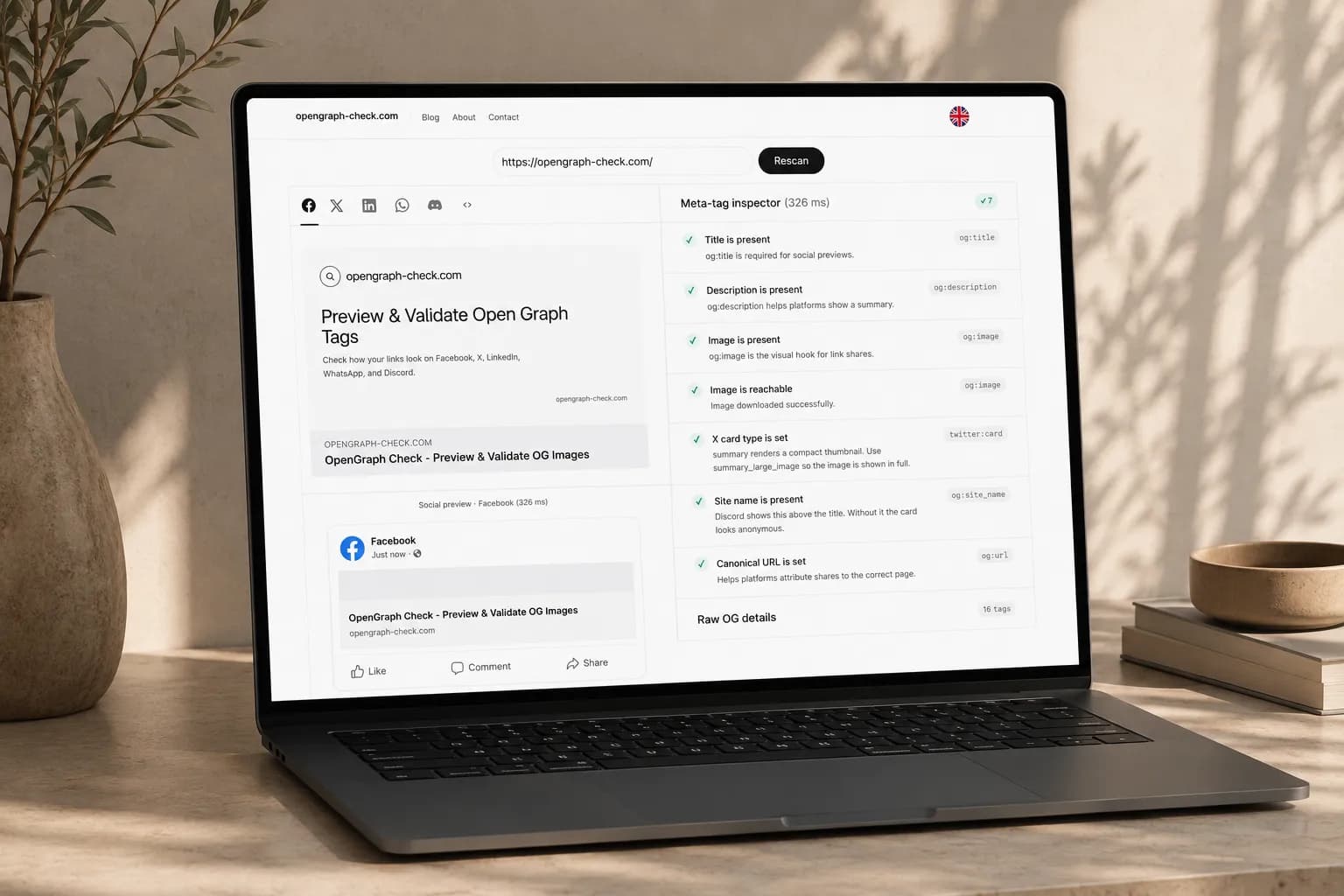
Detect missing tags

The scanner fetches your page exactly like a social crawler does, with no JavaScript, and flags missing or malformed og:title, og:description, og:image and twitter:card tags, plus wrong image dimensions (1200 × 630 px is the safe standard).

Improve click-through rates

A link with an image preview occupies roughly three times the feed space of a bare URL. Posts with complete Open Graph data consistently earn more clicks than links that render as plain text. The fix usually takes minutes.

Example Analysis

Try the demo

How the scan works

What is OpenGraph Check?

OpenGraph Check is a free online tool that scans any URL and shows how its link preview will look on Facebook, X, LinkedIn, WhatsApp, Discord and Slack. It validates Open Graph and Twitter Card meta tags, checks the og:image, and renders pixel-accurate previews for every major platform — no signup required. It is built and maintained by Tom Schindler, an independent software engineer based in Germany.

When you submit a URL, our server requests your page the same way Facebook's, LinkedIn's or WhatsApp's crawler would: a plain HTTP request that reads the raw HTML without executing any JavaScript. That distinction matters. Many modern sites inject meta tags client-side, and those tags are invisible to most social crawlers. If your Open Graph data only exists after JavaScript runs, this scan will show you exactly what the platforms see instead: nothing.

From the response we extract every Open Graph and Twitter Card tag in the document head, resolve relative image URLs against your domain, download the referenced og:image, and measure its actual dimensions and file size. The result is rendered as pixel-accurate previews for each platform, because every network crops and truncates differently. A title that fits on Facebook may be cut off on X.

What gets checked

  • Presence and content of og:title, og:description, og:image, og:url, og:type and og:site_name
  • Twitter Card tags (twitter:card, twitter:title, twitter:image) and their fallback behaviour
  • The og:image itself: whether it loads, its pixel dimensions against the 1200 × 630 recommendation, and its file size
  • Title and description length against each platform's truncation limits
  • Canonical URL and redirects that can cause platforms to scrape a different page than you expect

Reading the results

Missing tags are the most common finding and the easiest fix: add the tag server-rendered in your HTML head and re-scan. If tags look correct here but a platform still shows an old preview, the platform's cache is the culprit. Previews are cached per URL, sometimes for weeks. Re-scrape the link with the platform's own debugger (Facebook Sharing Debugger, LinkedIn Post Inspector) or share the URL with a query parameter appended to force a fresh fetch.

A frequent subtle issue is a correct og:image tag pointing to an image that is too large, too slow, or blocked for bots. Several platforms silently drop images that take longer than a few seconds to download or that block crawler user agents. The scan downloads your image the way a crawler does, so if it fails here, it will fail on the platforms too.

Supported platforms

  • Facebook
  • X
  • LinkedIn
  • WhatsApp
  • Discord
  • Slack

Open Graph FAQ

Scan any URL above for live results, or browse the guides below.

Open Graph tags tell social platforms what title, description, and image to show when someone shares your link. Most networks, including Facebook, X, LinkedIn, WhatsApp, Slack, and Discord, read these meta tags to build link previews.

Free SEO Tools

Guides & Resources